Surgeon Education · Haptic simulator for spine surgery and procedures
SpineVerse
FEEL THE SPINE. MASTER THE SURGERY.
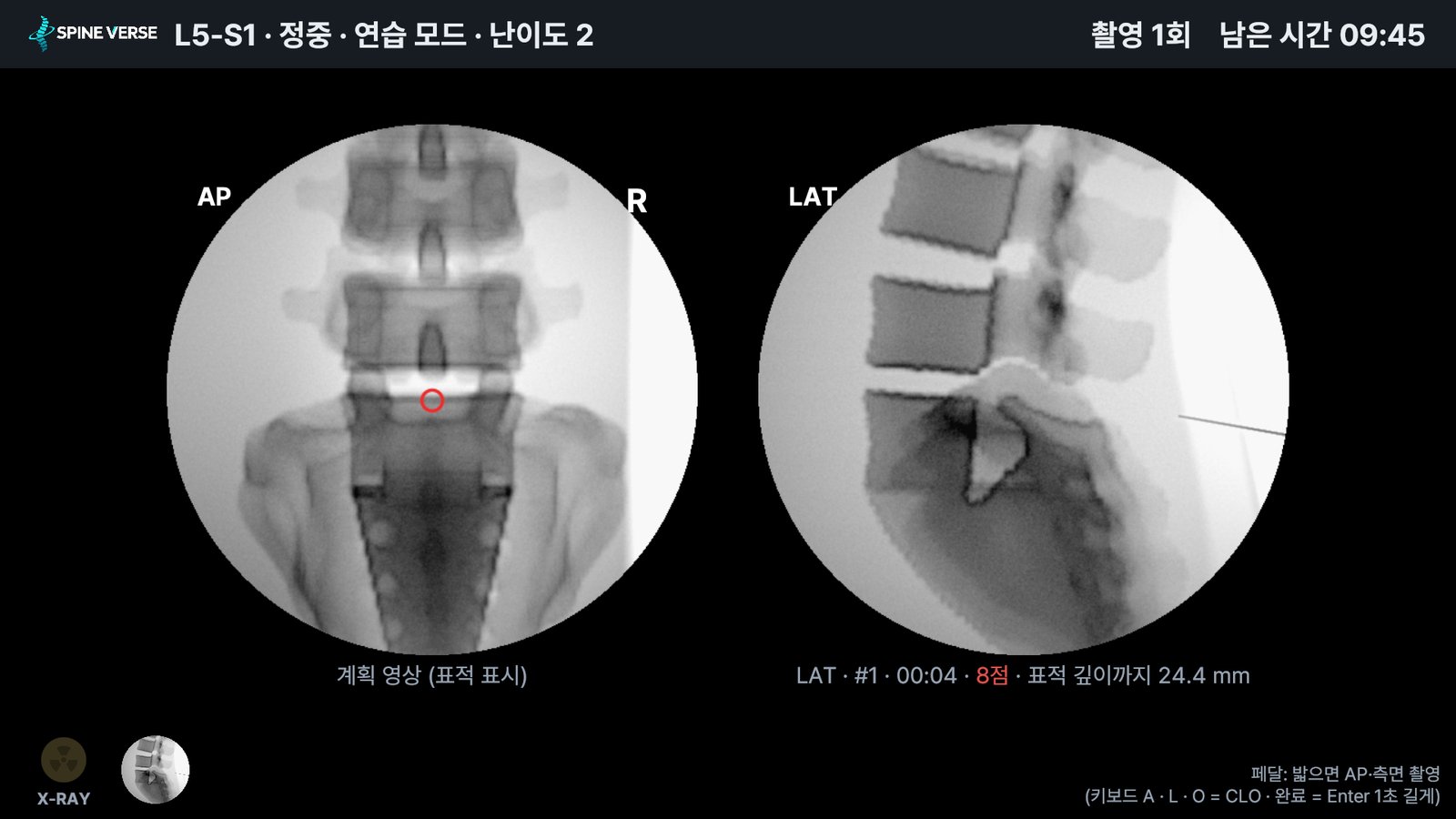 Prototype screen with demo data
SpineVerse is a haptic training simulator for practicing spine surgery and procedures repeatedly before treating real patients, with each performance recorded, assessed and fed back. It is designed so that trainees watch virtual C-arm (fluoroscopy unit) images while a haptic device, which transmits resistance to the hand, lets them feel the different resistance of each tissue layer. Every performance is recorded and returned as scores, AI feedback and the instructor's assessment.
Status
SpineVerse is currently a running development build (prototype) and is a product under development. Its functions have been checked through automated tests and simulation, and we plan to bring it to training sites after clinical review and usability evaluation with clinicians.
Background
Spine surgery and procedures take long practice to master, yet today's training relies on observation and limited hands-on practice, so there are not many chances to repeat enough before treating real patients.
- 01
Growing demand
As populations age, the number of patients with spine conditions is rising. The number of people with low back pain is estimated to reach 843 million in 2050 (WHO, 2023).
- 02
High difficulty
In spine surgery and procedures the anatomy is complex and there are many variables from patient to patient, so a high level of skill and clinical judgment are both needed.
- 03
Training that is hard to repeat
Today's training relies on observation, apprenticeship-style learning and practice on a limited supply of donated bodies (cadavers) or on simple models, which makes repeated training and standardization difficult.
- 04
A gap in assessment and feedback
Systems that assess performance with quantitative measures and give feedback are rare. Differences in skill between clinicians can lead to variation in service quality.
Overview
FEEL THE SPINE. MASTER THE SURGERY. SpineVerse is a simulation platform for training in spine surgery and procedures that uses a haptic device to train the feel in the hands as well. It was conceived by a spine specialist and, following clinical input, takes needle insertion, the most important first step, as its first training target.
Repeat
Trainees practice without a limit on the number of attempts, in an environment similar to a real patient situation. It is built on standard scenarios in which the same task is repeated against the same criteria.
Feel
In addition to watching the screen, trainees feel by hand, through the haptic device, the resistance of touching and entering tissue. It is designed so that each layer gives a different resistance, and the feel on the physical device is still being tuned.
Record and feedback
Path, depth, angle and time are recorded and returned as quantitative assessment and feedback. Results can be reviewed as scores, a 3D replay, AI feedback and a report.
Instruction
Instructors watch performance in real time on the web and assess it on the basis of the record.
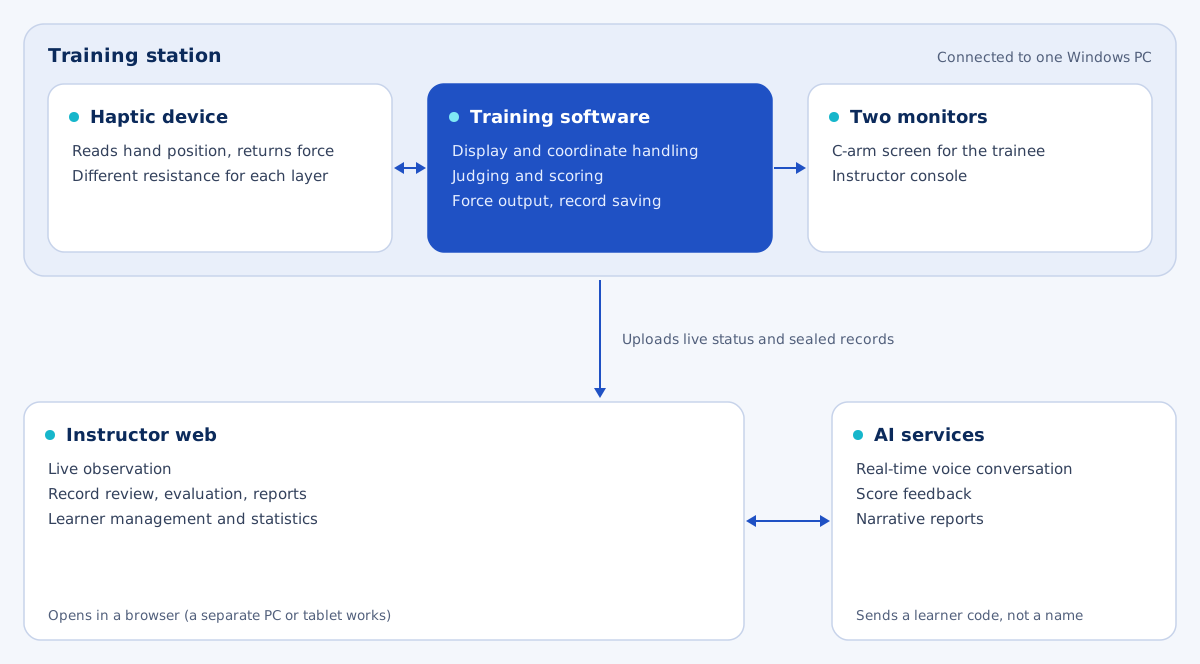
System layout: judging and force output happen at the station; observation and evaluation happen on the web.
Screens
The trainee screen in needle insertion training, showing the target marker on the virtual C-arm anteroposterior (AP) planning image side by side with the lateral (LAT) image of the needle going in. 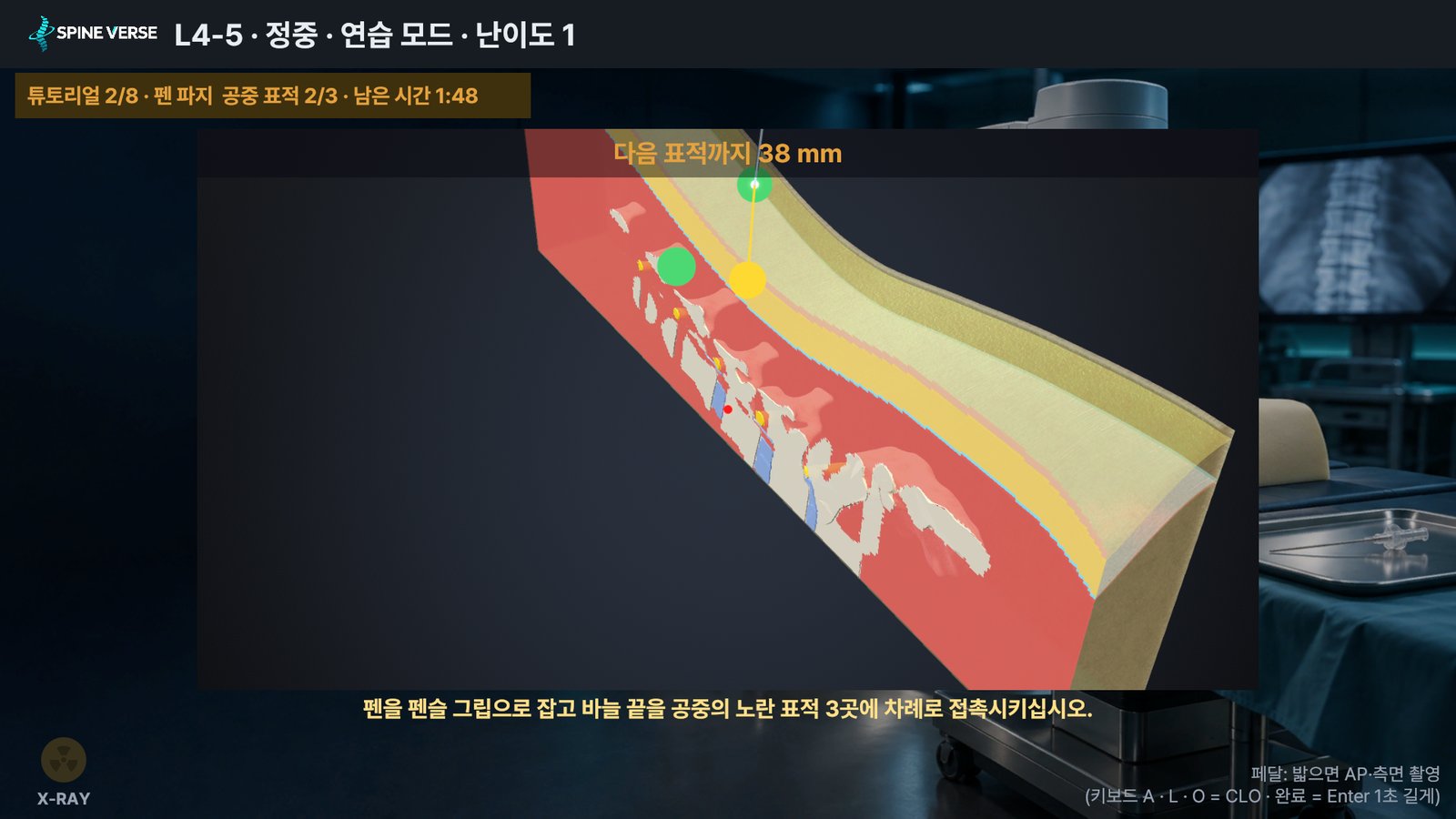
A tutorial screen: on a 3D view showing a cross-section of the tissue layers, the trainee touches the needle tip to targets in the air one by one to learn how to handle the device. 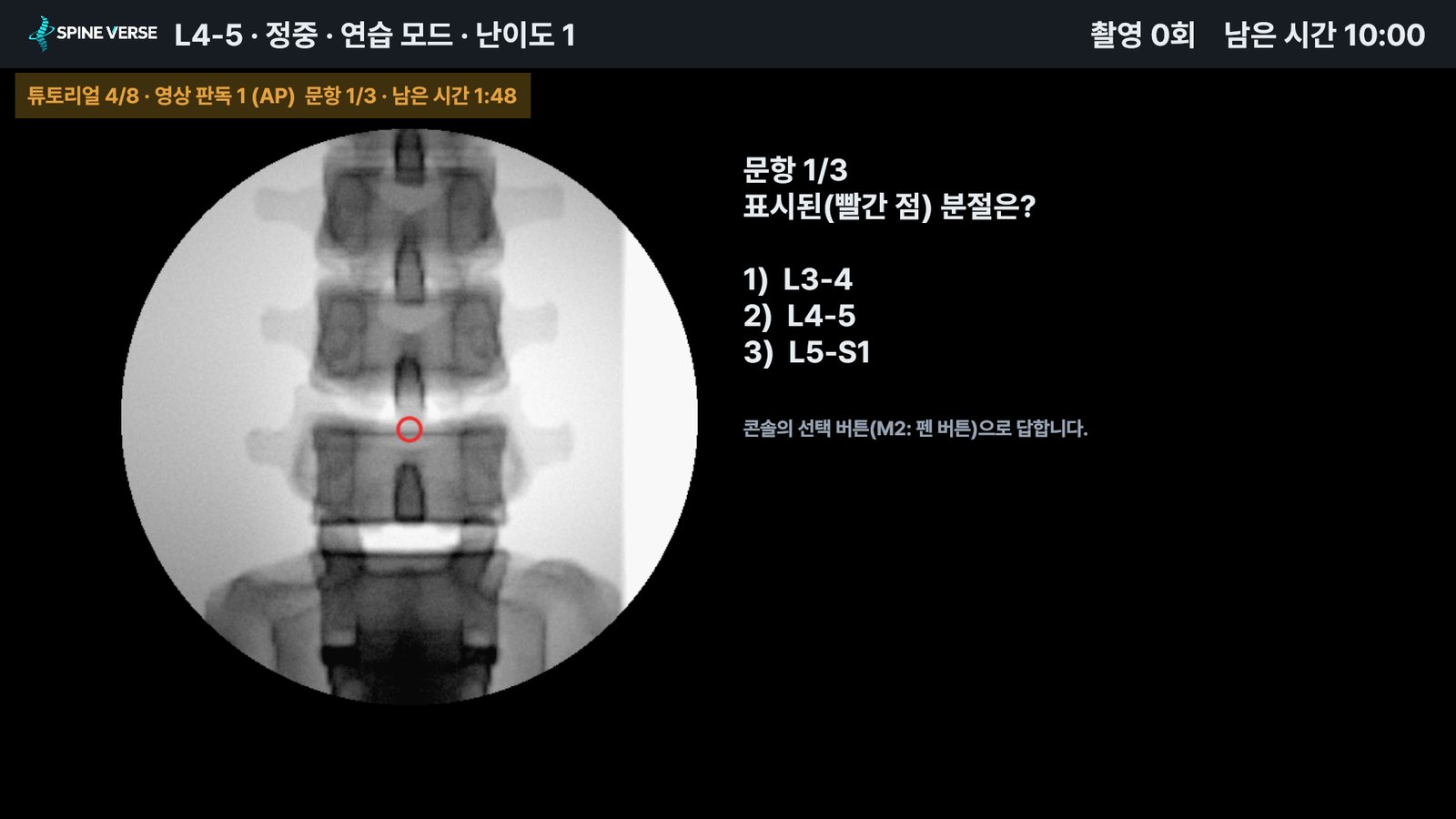
The C-arm image reading step of the tutorial: a question asking which spinal level is marked on the anteroposterior (AP) image. 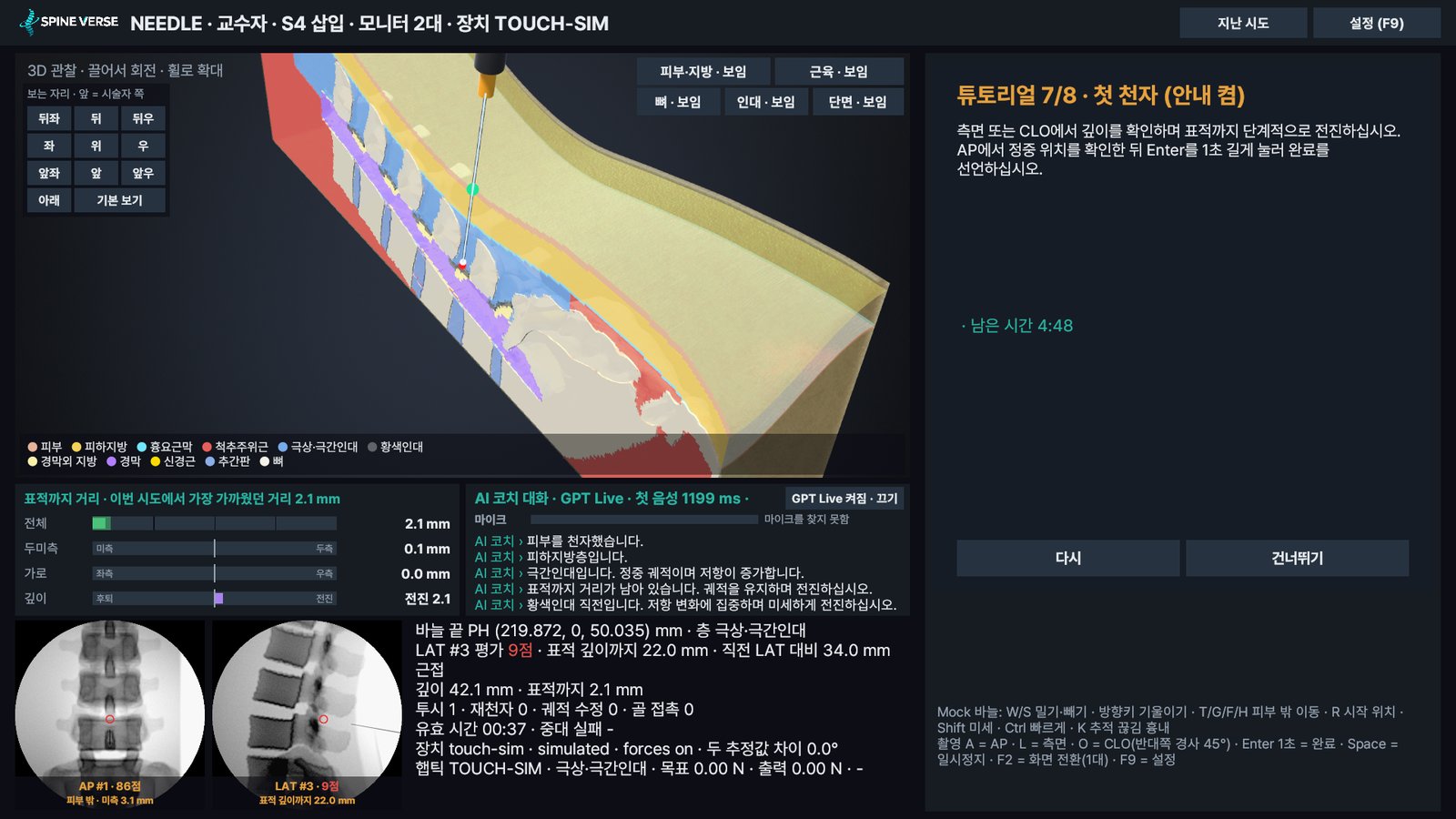
The instructor console in needle insertion training, with a 3D observer view of the tissue layers and needle, distance to target, the AI coach conversation and C-arm images on one screen. 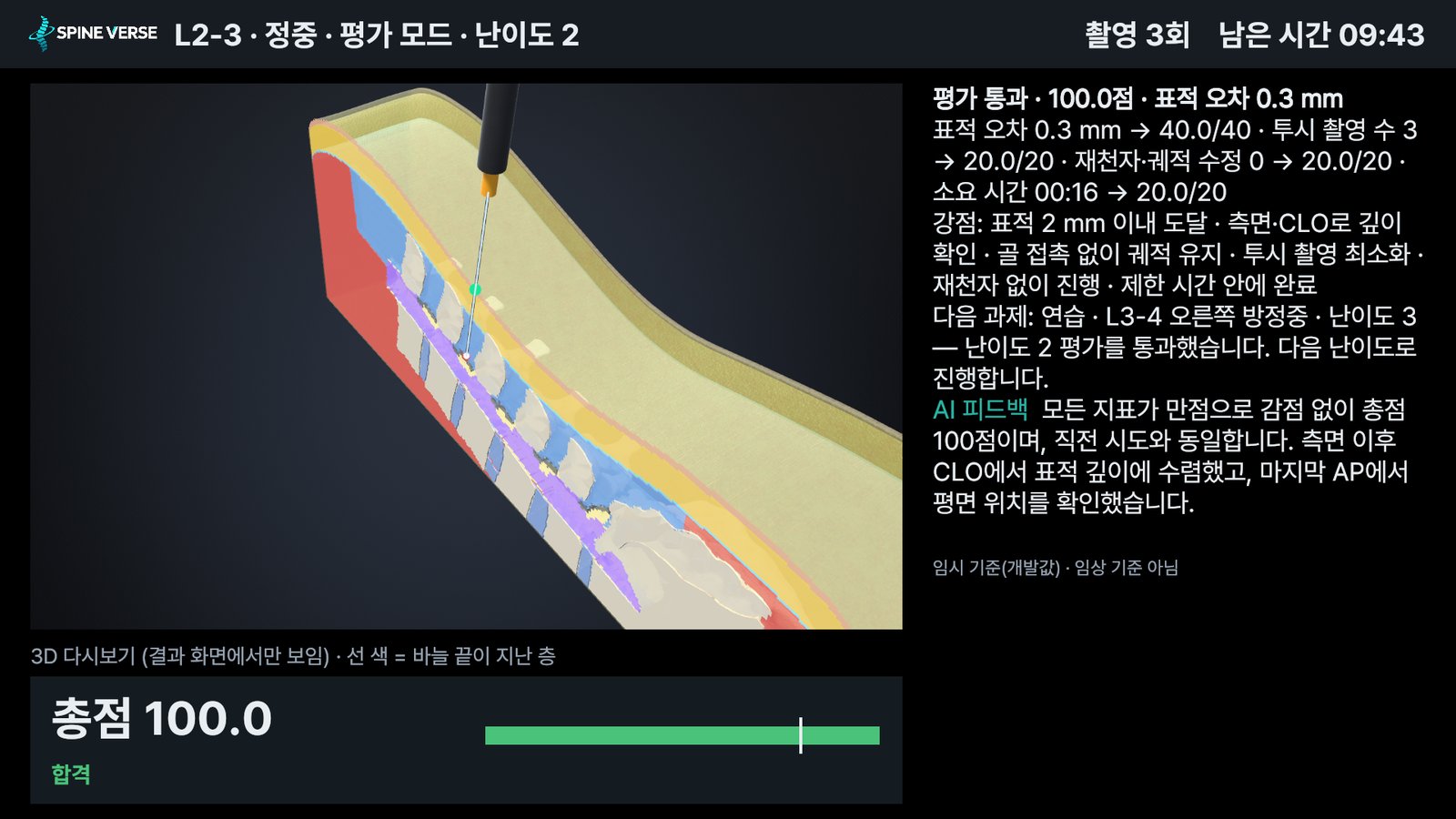
The assessment result screen, showing the total score and item scores, a 3D replay of the needle path and AI feedback together. 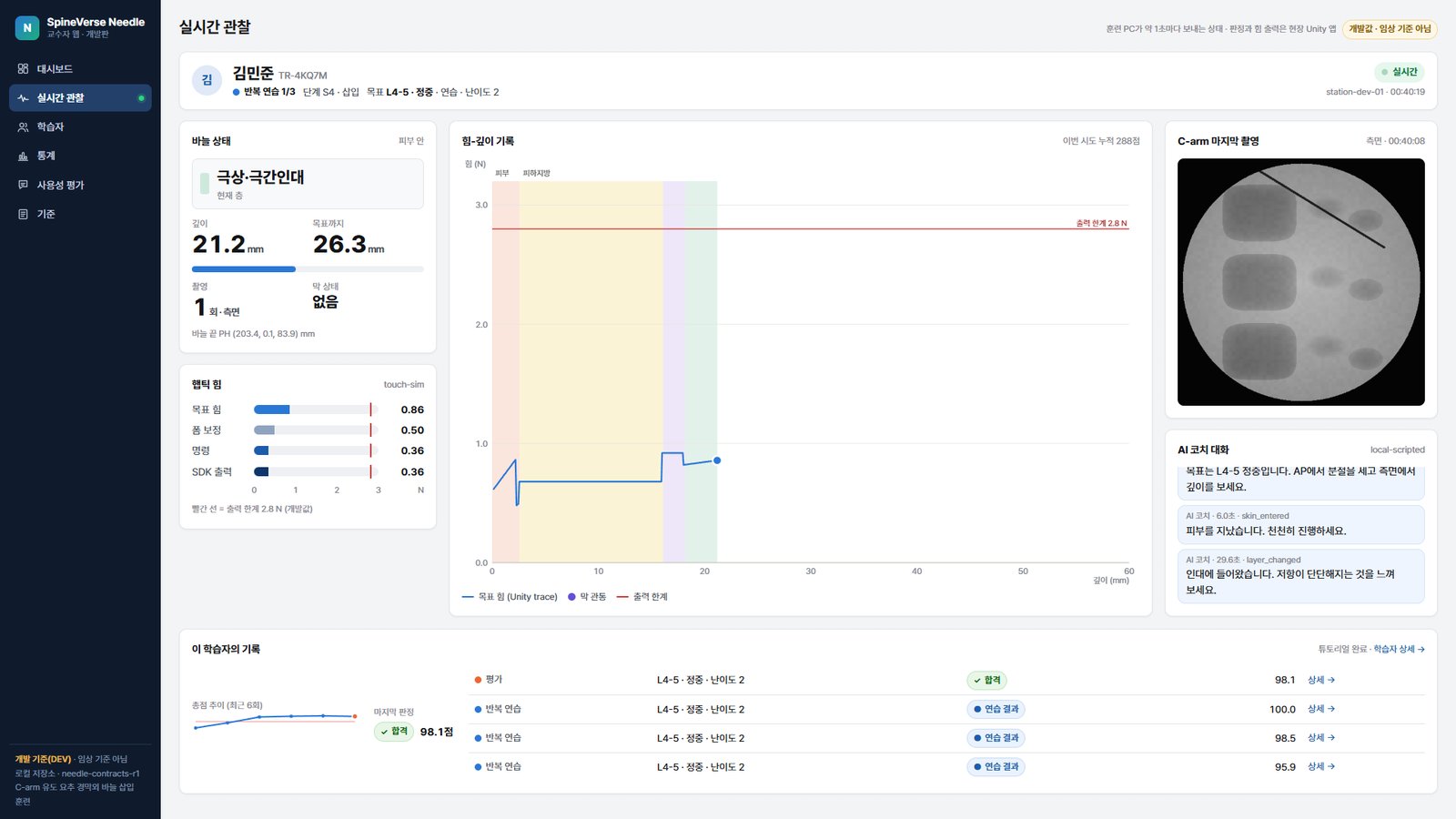
The real-time observation screen of the instructor web, showing the current layer and depth, a force-depth graph, the latest C-arm image, the AI coach conversation and the trainee's past records.
Features
The current development build consists of needle insertion training, the instructor web, and the AI coach and feedback. The features below were confirmed to work in automated tests or simulation as of November 20, 2026, which is separate from any review of clinical validity.
01Needle insertion training
Virtual C-arm
Anteroposterior (AP), lateral and oblique (CLO 45°) fluoroscopic images are taken by pressing a foot pedal. Watching these images, the trainee inserts a needle mounted on the tip of the haptic device's stylus into a back model to reach the target point.
Resistance by layer
The haptic device produces a different resistance for each tissue layer the needle passes through and transmits it to the hand (12 material types). The feel on the physical device is being tuned.
Training in stages
Training proceeds through an 8-step tutorial, practice (difficulty 1 to 3) and assessment. In assessment, the target marker and the coach's voice are turned off.
Scores and critical failures
Out of 100 points, scoring covers target error (40), number of fluoroscopy shots (20), re-punctures (inserting the needle again) and trajectory corrections (20), and time taken (20). Dural puncture, wrong-level identification, penetration of the ligamentum flavum and nerve root contact result in a fail regardless of the score. The thresholds are development values.
02Instructor web
Real-time observation
The instructor sees the current layer, depth and distance to target, a force graph, the latest C-arm image and the coach conversation.
Records and assessment
Instructors view per-attempt scores, captured images, path replay and reports, and assess using the instructor assessment form. The pass score can be set between 50 and 100 points, with a default of 80.
Trainee management and statistics
For each trainee, instructors see the learning curve, error frequency, results by spinal level and recommended tasks, along with statistics on averages and pass rates by stage, spinal level and difficulty.
03AI coach and feedback
Voice coach
Step guidance, layer entry notices and warnings are played as recorded voice, and when the trainee asks a question aloud the coach answers by voice. Real-time voice conversation works only in practice, and the coach stays silent during assessment. Both the screens and the voice support Korean and English.
AI feedback and reports
When an attempt ends, it explains in writing what went well and what to improve for each scoring item, and produces a narrative report based on the attempt record. Score calculation is rule-based, and the AI handles explanation, conversation and reports.
How it works
This is the flow in the current development build.
- 01
Choose the task
After logging in, the trainee chooses the spinal level, mode and difficulty to train on. The targets are five lumbar levels (L1-2 to L5-S1), and the current back model supports the midline approach only.
- 02
Tutorial
First-time trainees go through an 8-step tutorial that covers, in order, handling the equipment, reading C-arm images, feeling the layers and a first insertion.
- 03
Practice
The trainee checks the target on the planning image, inserts the needle and takes images with the foot pedal to check position and depth. If it is wrong, the needle can be withdrawn and inserted again, and the voice coach announces layer entry and warnings.
- 04
Assessment
The task is performed with the target marker and the coach's voice turned off. When the trainee declares completion, the result is judged by the needle tip position, and any critical failure means a fail regardless of the score.
- 05
Review the result
The result screen shows the score, a 3D replay, AI feedback and the report. After training, the coach asks five questions and the trainee leaves feedback in a five-item survey.
- 06
Records and instructor assessment
The attempt record is uploaded to the instructor web, where the instructor reviews the score, captured images and path replay and assesses using the assessment form. The learning curve and recommended tasks lead into the next training session.
Who it is for
Trainees: residents and fellows
It is designed so that they can practice repeatedly before performing procedures on real patients and review their own performance through scores, a 3D replay and AI feedback. With a voice coach, the aim is for them to be able to train on their own even without an instructor beside them.
Instructors: supervising specialists and education managers at medical institutions
It is designed so that they can observe performance in real time on the instructor web and assess it on the basis of per-attempt records, path replay, the instructor assessment form and learning curves.
Adopting institutions: hospitals, medical schools and training institutions
The aim is to reduce variation in training quality and skill through a standardized training course, and to ease the time, space and cost burden of cadaver practice and in-person workshops. These are goals set out in our business plan, and the actual effect has not yet been measured.
Technology
One set consists of a training station and the instructor web. Judging and force output are completed within the station, and the web handles observation, management and assessment.
Training station
A haptic device and two monitors are connected to a single Windows PC. The monitors show the trainee's C-arm screen and the instructor console. The setup also uses a foam-filled back model, a USB foot pedal for taking images, and a microphone and headset for the voice coach.
Haptic device
A haptic device reads the position of the hand and returns force. We use one 3D Systems Touch unit. Output force is reduced when it exceeds 2.8 N and cut off at 3.0 N.
Training software
The Unity-based training software handles display, coordinate processing, judging, haptic force output and record storage. There is a mode that runs without a haptic device, which allows demonstrations and inspection.
Records and sealing
For each attempt, position, force, events and captured images are saved, sealed with a hash for tamper checking and uploaded to the instructor web. If the connection is lost, they are kept on the station and uploaded later. Needle insertion records are sampled 100 times per second.
AI services and personal information
AI services are used for voice conversation, score feedback and reports. Authentication keys are kept only on the web server, and names and dates of birth are not sent to the AI. Only a trainee code is passed. If an AI call fails, a rule-based report is used instead.
Anatomical models and content
The anatomical models of the lumbar spine, discs, ligaments, nerves and tissue layers are generative 3D models adjusted to dimensions from the literature. Models based on medical imaging (CT) are planned for the next stage, and the anatomical coordinates, targets and risk zones have not yet undergone clinical review.
Adoption
It is currently in development, and the forms of adoption below are plans written in our business plan.
Currently a development build
It is currently a development build (prototype) that is still under development, and we are preparing for pilot adoption. It is software for education and training and is not a medical device. The instructor web has been inspected locally and has not yet been deployed externally for operation.
Installation
It takes the form of a station placed on a desk or cart, using a general-purpose haptic device, a Windows PC and two monitors. The instructor web is accessed through a browser and can also be viewed on a separate PC or tablet.
Institutional license (planned)
We are planning a license model in which hospitals, medical schools and training institutions adopt it at the institutional level. The direction in our business plan is then to expand the training content and functions and develop it into an education and training platform service.
Starting with pilots (planned)
We plan first to go through usability evaluation with clinicians and pilot operation at partner institutions in Korea, and then to expand to hospitals and medical schools in Korea. This is a plan from our business plan, not a confirmed schedule.
Roadmap
June 2026
We filed two patent applications in Korea (June 12, 2026; at the application stage, not granted).
October 2026
At the interim results presentation for the Early-Stage Startup Package, we reported the implementation of the full needle insertion process and the virtual C-arm.
November 2026 (now)
It is a running development build. Needle insertion training has passed 261 automated functional tests, and through December 2026 we plan to carry out alignment with the physical haptic device, tuning of the feel, and clinical review of the anatomy and risk zones.
January 2027 (target)
The target is to finish internal functional inspection and complete the needle insertion training prototype, which is the deliverable for the agreement period (April 2026 to January 2027).
February to September 2027 (planned)
We plan a usability evaluation with clinicians in February to March, followed by enhancement, beta testing and preparation for launch.
Second half of 2027 onward (planned)
We plan to start with pilot adoption at hospitals and medical schools in Korea and to expand into more content and functions and overseas partnerships. This is a plan from our business plan, not a confirmed launch schedule.
FAQ
Is SpineVerse a medical device?
No. SpineVerse is software for education and training and is not a medical device. If we extend it to functions with a medical purpose in the future, we plan to pursue the necessary certifications and regulatory approvals.
Can we adopt it now?
Not yet. It is currently a development build that is still under development, and we are preparing for pilot adoption at partner institutions in Korea following usability evaluation with clinicians. There is no confirmed launch schedule.
Has clinical review or verification of training effect been completed?
Not yet. So far we have confirmed that the functions work through automated tests and simulation, and the anatomical coordinates, targets, risk zones and scoring criteria are development values. Clinical review and usability evaluation with clinicians are the next stage, and training effect has not yet been measured.
What kind of display is used for training?
The current development build uses two monitors. Immersive VR/XR environments are outside the initial scope and are planned for the next stage.
Does AI do the scoring?
No. Score calculation is rule-based, and the AI handles explanation, conversation and reports. An AI assessment model trained on performance data is planned for the next stage.
Is trainees' personal information sent to the AI?
Names and dates of birth are not sent to the AI. Only a trainee code is sent. Authentication keys are kept only on the web server.
Notice
SpineVerse is software for education and training and is not a medical device.